TCM field notes · tea pairing
Qi Deficiency in TCM: What the Traditional Constitution Framework Describes
By Biohack.BaZi Editorial Team · Published · How we work
Qi deficiency (气虚质, qì xū zhì) is one of the nine traditional constitution categories described in the Chinese Medicine Constitution Questionnaire framework. Here, it is a traditional description for cultural learning, not a diagnosis.
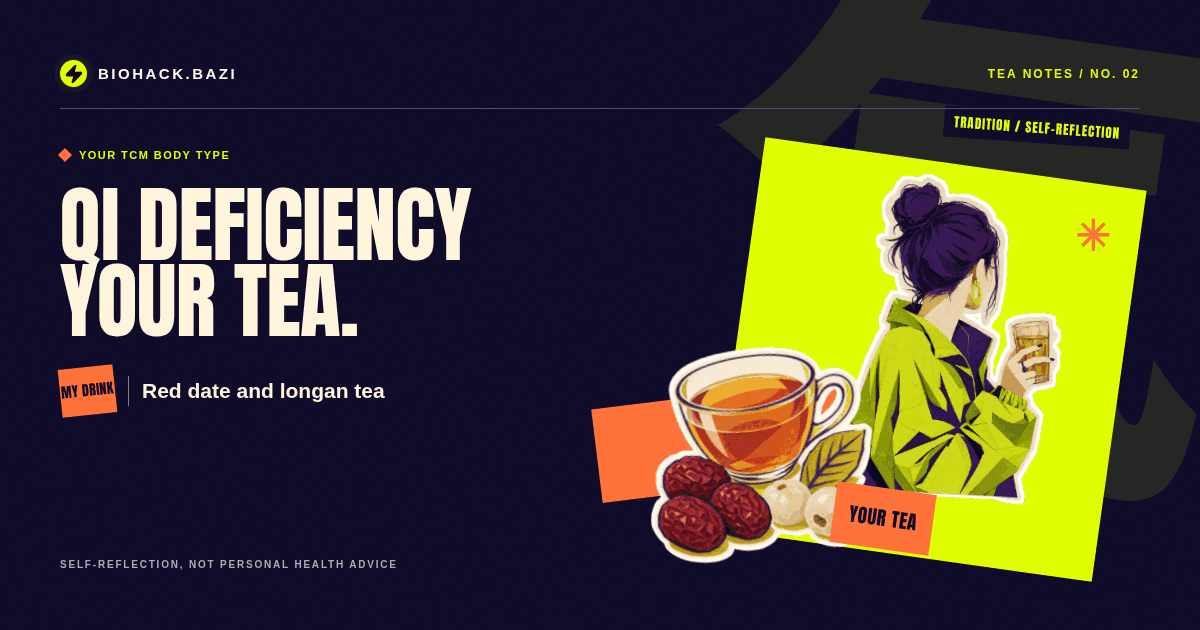
Self-assessment results are for cultural learning. They are not a diagnosis.
What is qi deficiency in TCM?
Qi deficiency is one category in the traditional Chinese Medicine Constitution Questionnaire. A peer-reviewed paper about the questionnaire describes the nine categories and its Qi-deficiency item group. This is a classification framework, not a medical label.
The paper does not validate this site's original 20-question self-reflection or show that a food or routine changes a result. For more context, take the free 20-question test, read about the nine TCM body types, or explore tea pairings by body type.
What signs does the traditional constitution framework describe?
The peer-reviewed article lists questionnaire prompts about getting tired easily, shortness of breath, palpitations, dizziness including when standing, preferring quiet, a weak voice, catching colds more easily than others, and sweating after slight activity. These are items in the studied instrument.
They are not a diagnostic checklist. This site uses a separate original questionnaire and does not reproduce the research instrument or scoring, so its questions and results should not be compared with the study.
How do daily habits fit in?
This page does not prescribe a routine, diet, supplement, exercise plan, or treatment. For reflection, note when an experience occurs and whether it affects ordinary activities.
Those notes are context, not confirmation of a traditional label. If a score feels out of step, you do not need to force it to fit.
This page does not recommend specific foods or drinks for this type.
How is this different from a medical diagnosis?
A traditional constitution category and a medical diagnosis are different statements. This site's original self-reflection is not the Chinese Medicine Constitution Questionnaire studied in the paper and is not a diagnostic test.
A website result cannot identify a cause, confirm or rule out a condition, or decide what care is appropriate. Do not change medication or delay care based on it.
The NIH NCCIH provides general information about traditional Chinese medicine and advises discussing care with health professionals. It does not validate this category or questionnaire.
When should you see a doctor or registered TCM practitioner?
For health concerns, persistent symptoms, or treatment questions, speak with a qualified healthcare professional instead of relying on an online category.
In Singapore, the TCM Practitioners Board provides public information about the profession and registration. Check its current details and share concerns, medicines, and relevant history with the professionals involved in your care.
The NCCIH overview is general information, not endorsement of this self-assessment.
Frequently asked questions
What is qi deficiency in TCM?
It is one category in the traditional nine-constitution framework described by the Chinese Medicine Constitution Questionnaire. On this site, the term is used for cultural learning and is not a diagnosis.
Which signs are listed in the Qi-deficiency questionnaire?
The cited paper lists questionnaire prompts about easy tiredness, shortness of breath, palpitations, dizziness, preferring quiet, a weak voice, catching colds more easily, and sweating after slight activity. They are research questionnaire items, not a diagnostic checklist for this website.
Does this self-assessment diagnose Qi deficiency?
No, it is an original self-reflection tool and does not reproduce the Chinese Medicine Constitution Questionnaire. It cannot identify the cause of symptoms or determine what care is appropriate.
When should I speak with a professional?
For health concerns, persistent symptoms, or treatment questions, contact a qualified healthcare professional instead of relying on an online category. In Singapore, consult the TCM Practitioners Board's current public information when checking practitioner registration.
Sources
- Peer-reviewed paper on the Chinese Medicine Constitution Questionnaire
The article describes the constitution questionnaire and its Qi-deficiency item group.
- Singapore TCM Practitioners Board, For the Public
Official public information from Singapore's TCM Practitioners Board.
- NIH National Center for Complementary and Integrative Health, Traditional Chinese Medicine
General information about traditional Chinese medicine and questions to discuss with health professionals.