Article
Map Your Nobleman Star in Minutes With a Free AI Calculator
Map Your Nobleman Star in Minutes With a Free AI Calculator
The Nobleman Star (Tian Yi Gui Ren) is an auxiliary BaZi marker tied to your Day Master, and it signals timely help from mentors, connectors, or unexpected allies. It works as a modifier, not a guarantee. A Nobleman placement can soften hard patches in your chart, but only when the branch it sits on actually supports your elemental needs. The mapping table below shows you exactly where to look.
TL;DR:
- The usefulness of your Nobleman Star depends heavily on whether its branch supports your elemental needs, not just its presence in your chart.
- The star’s impact varies based on placement in natal, Luck Pillar, or annual positions, with natal placements indicating long-term patterns and others showing temporary windows of support.
- Accurate identification requires checking your specific Day Master against a fixed mapping table, which can be automated with tools like the Biohack.BaZi calculator.
- Recognizing real support involves noting small, unprompted acts of help that often go unnoticed but can be tracked over time to reveal helpful patterns.
- The true value lies in acting swiftly when help arrives during these windows, ensuring responses are specific, timely, and log-based to maximize the benefit.
Table of Contents
- What the Nobleman Star Actually Means in Bazi
- How Do You Find Your Nobleman Star?
- Why Placement and Timing Change What the Nobleman Star Does
- What Nobleman Help Actually Looks Like
- How to Recognize and Act on Nobleman Support
- How Biohack.Bazi Maps Your Nobleman Placements
- What the Conventional Advice Gets Wrong
- Find Your Nobleman Star in Minutes, Not Hours
- Sources
- FAQ
What the Nobleman Star Actually Means in Bazi
The Nobleman Star isn’t a planet or a fixed point in the sky. It’s a symbolic marker, one of dozens of auxiliary stars BaZi practitioners layer onto the Four Pillars chart to add texture to what the Day Master and elements already reveal. Think of it as a note in the margins of your elemental blueprint, flagging where outside help tends to concentrate.
Traditional texts and modern teachers describe the Nobleman in fairly consistent terms: a benefactor figure, sometimes called an “earth angel,” who shows up with a timely introduction, a piece of advice, or a shortcut through red tape. Some practitioners frame it as a healer archetype, someone who appears precisely when you’re stuck. Others treat it more literally, as a signal that certain people (mentors, senior colleagues, even strangers) are more likely to extend a hand when your chart calls for it.
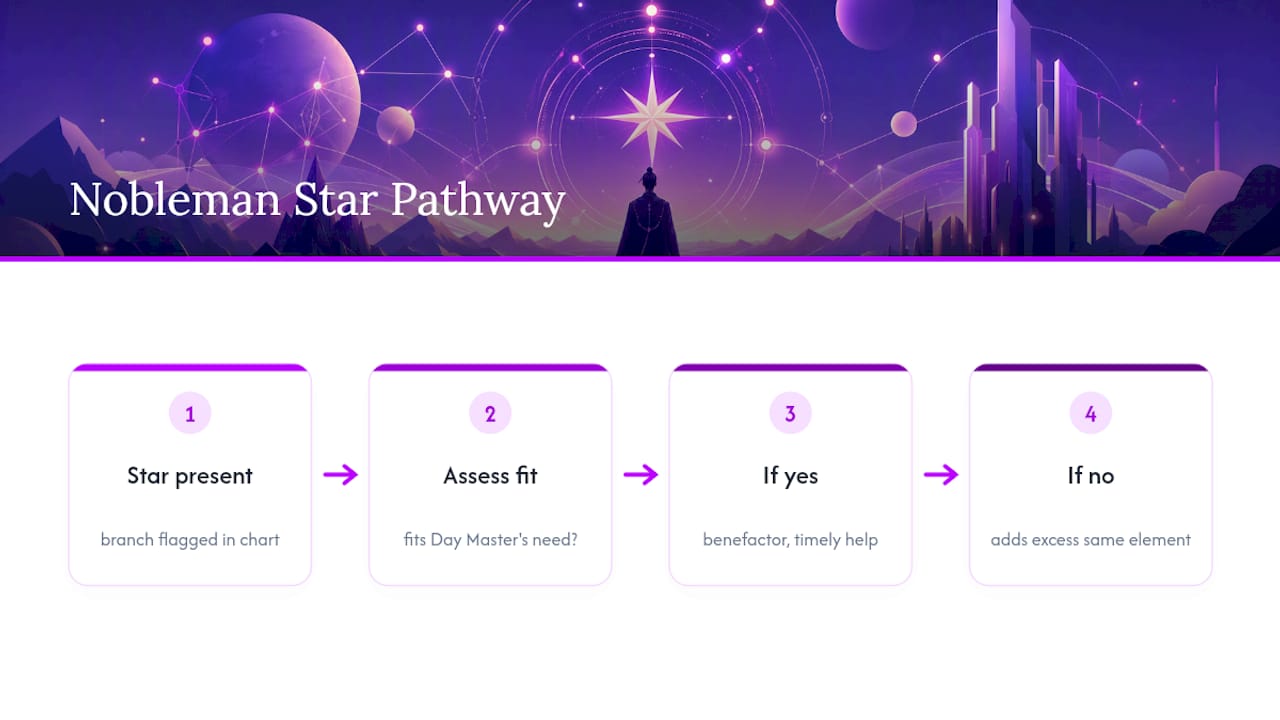
Here’s where most beginners get tripped up. A Nobleman Star doesn’t work in isolation. The Heavenly Nobleman only delivers real benefit when the Earthly Branch it occupies is genuinely useful to your Day Master. If your chart already runs hot with a particular element and the Nobleman branch pours more of that same element in, you get noise, not help. Usefulness depends on your whole elemental balance, not just the presence of the star.
That’s the nuance that separates a casual reading from a serious one. Two people with the same Nobleman branch in their chart can experience wildly different outcomes depending on what their Day Master needs. One person’s benefactor sign is another person’s non-event. This is exactly why practitioners insist on checking chart balance before declaring a Nobleman “active.” A star on paper means little until you know whether your chart is thirsty for what it offers.
How Do You Find Your Nobleman Star?
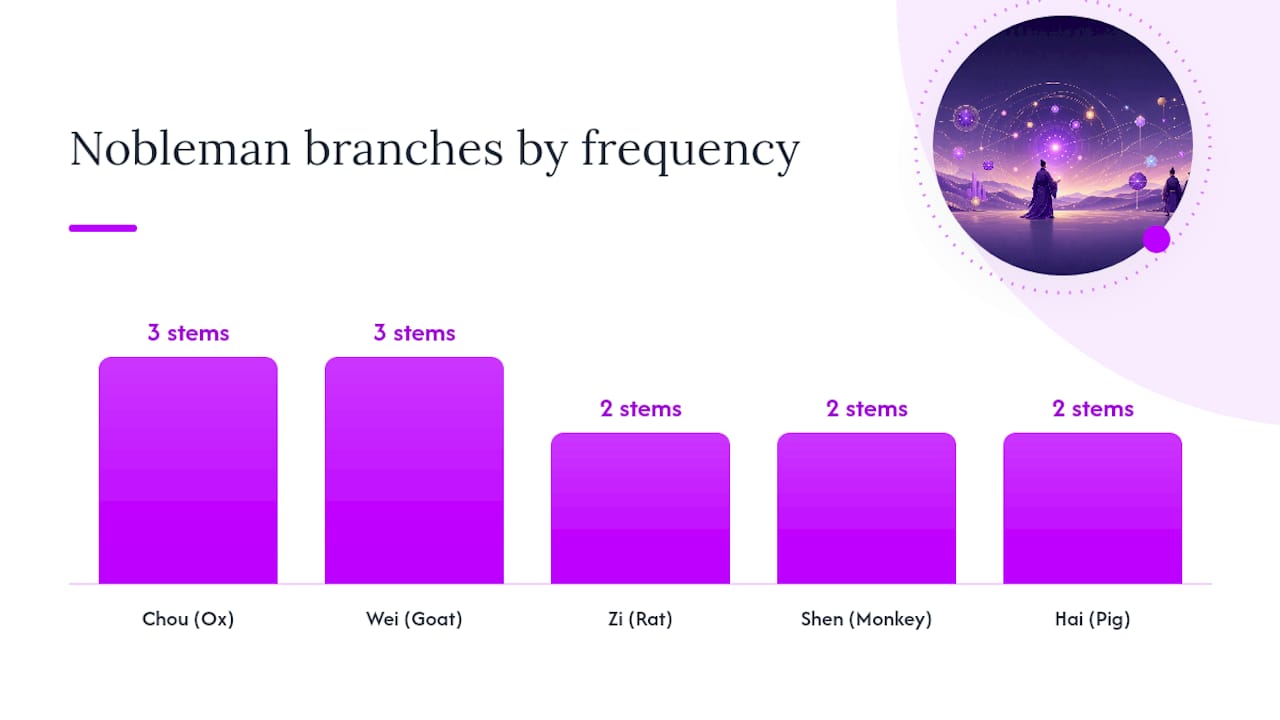
Every Day Master (the Heavenly Stem representing you in your Day Pillar) maps to two specific Nobleman branches. These pairings come from classical BaZi lookup tables, and they don’t shift based on gender, birth year, or any other variable. Your Day Stem is fixed at birth, and so is its Nobleman mapping.
Here’s the standard mapping used across most BaZi teaching lineages, as outlined in Feng Shui By Jen’s breakdown of Nobleman placements:
| Day Master (Heavenly Stem) | Nobleman Branches |
|---|---|
| Via (Yang Wood) | Chou (Ox), Wei (Goat) |
| Yi (Yin Wood) | Zi (Rat), Shen (Monkey) |
| Bing (Yang Fire) | Hai (Pig), You (Rooster) |
| Ding (Yin Fire) | Hai (Pig), You (Rooster) |
| Wu (Yang Earth) | Chou (Ox), Wei (Goat) |
| Ji (Yin Earth) | Zi (Rat), Shen (Monkey) |
| Geng (Yang Metal) | Chou (Ox), Wei (Goat) |
| Xin (Yin Metal) | Wu (Horse), Yin (Tiger) |
| Ren (Yang Water) | Mao (Rabbit), Si (Snake) |
| Gui (Yin Water) | Mao (Rabbit), Si (Snake) |
To locate your own Nobleman Star, work through it in order:
- Identify your Day Master, the Heavenly Stem sitting in your Day Pillar.
- Match that stem to its Nobleman branches using the table above.
- Scan your Year, Month, Day, and Hour Pillars for those branches.
- Check your current Luck Pillar and this year’s annual branch for the same match.
Say your Day Master is Bing (Yang Fire). Your Nobleman branches are Hai (Pig) and You (Rooster). If your Hour Pillar happens to carry a You branch, you have a natal Nobleman placement sitting close to your personal expression and later-life patterns. If neither branch shows up natally but You arrives in your current ten-year Luck Pillar, the star is activating temporarily, not permanently. That distinction shapes how you read its influence, which the Day Master guide covers in more depth if you want to understand why your stem behaves the way it does.
Why Placement and Timing Change What the Nobleman Star Does
A Nobleman branch sitting in your Day or Hour Pillar tends to be the easiest version to read. These positions relate closely to your core identity and your later-life trajectory, so a natal Nobleman here often shows up as a recurring pattern: a mentor who reappears across different jobs, a family connection that keeps opening doors, a friend group that consistently steers you right.
A Nobleman that only appears in your Luck Pillar or in a given year’s annual branch behaves differently. It’s a temporary window, not a fixed trait. During that Luck Pillar or that specific year, the conditions for benefactor help are more favorable than usual. Outside that window, the effect fades.
- Natal placements (Day/Hour) tend to describe a long-running pattern in how help finds you.
- Luck Pillar activations describe a decade-long window where that pattern strengthens.
- Annual branch activations describe a single year where the star is “switched on.”
This is where the usefulness rule matters most. A Nobleman branch that arrives during a Luck Pillar still has to serve your Day Master’s actual elemental needs to mean anything. According to Master Sean Chan’s analysis of the Heavenly Nobleman, an auxiliary star resting on a branch your chart doesn’t need provides little real benefit, no matter how favorably it’s timed. A Nobleman year can pass you by entirely if the branch conflicts with what your Day Master requires for balance. Timing tells you when to pay attention. Usefulness tells you whether it’s worth paying attention to at all.
What Nobleman Help Actually Looks Like
Nobleman assistance rarely looks like divine intervention. Practitioners who study this pattern closely point out that it tends to arrive as something small and easy to dismiss: a passing comment, an unsolicited introduction, a favor someone offers almost casually. Recognizing it requires paying attention to ordinary moments, not waiting for a dramatic rescue.
Here’s what that looks like across different areas of life:
- Career: A former colleague mentions your name in a meeting you weren’t even in, and it lands you an interview.
- Health: A stranger in a waiting room recommends the one specialist who finally identifies your condition.
- Travel: A gate agent quietly rebooks you onto an earlier flight after a cancellation, no explanation needed.
- Legal: A friend’s cousin, who happens to be a paralegal, flags a filing error before it costs you money.
- Education: A professor you barely spoke to writes you a recommendation letter that changes an admissions decision.
- Finance: A bank teller mentions a fee waiver program you didn’t know existed, saving you hundreds.
None of these moments announce themselves. That’s the point. The help is real, but it’s wrapped in the ordinary, which is exactly why so many people miss it entirely.
How to Recognize and Act on Nobleman Support
Spotting a Nobleman event after the fact is easy. Catching it while it’s happening takes practice. A few habits make the difference between noticing help and letting it slide past unused.
- Pay attention when someone offers something small and unprompted, an introduction, a tip, a contact.
- Follow up within a day or two. Nobleman windows tend to close quietly if you wait too long.
- Keep your ask specific. Vague requests for help are harder for a benefactor figure to act on than a clear, narrow one.
- Log the event: date, who helped, what they offered, and what pillar or cycle you were in at the time.
Over months, that log starts to reveal patterns. You’ll notice certain periods (often tied to a Luck Pillar or annual branch) where offers of help cluster, while other stretches stay quiet no matter how much you network. That’s usable data, not superstition. Practitioners who track this seriously cross-reference the helper’s branch and the date against their Luck Pillar and annual animal to confirm whether the timing lines up with what the chart predicts.
Pro Tip: Keep a simple running note, even a single line per entry, every time someone offers unsolicited help. After a year, review it against your Luck Pillar timeline. The clustering pattern often tells you more than any single reading could.
Building this habit doesn’t require mastering the whole system first. It just requires noticing what the Four Pillars structure already tells you about when to expect these windows, and staying alert enough not to miss them.
How Biohack.Bazi Maps Your Nobleman Placements
Manually cross-referencing Day Master tables against four pillars and a rotating Luck Pillar takes time and invites errors. Biohack.BaZi’s free calculator runs that lookup automatically, generating a downloadable elemental chart that flags Nobleman branches alongside your broader TCM constitution themes. The AI-assisted read pairs classical stem-to-branch mapping with lifestyle prompts, so you see not just where your Nobleman sits, but how it fits your current elemental picture.
What the Conventional Advice Gets Wrong
Most explanations of the Nobleman Star stop at the definition. They tell you the star exists, maybe show you a mapping table, and leave you to guess what to do with it. That’s backwards. The real value isn’t in knowing you have a Nobleman branch. It’s in recognizing the specific, small moments when that branch is doing its work and responding fast enough to matter.
The usefulness rule gets underweighted, too. Plenty of casual readings treat any Nobleman placement as automatically favorable, when the classical framework is clear that a branch has to serve your Day Master’s actual needs to help at all. A Nobleman sitting on an element you’re already saturated with is closer to background noise than benefactor energy.
If you’re studying your own chart, prioritize two things first: confirm whether your Nobleman branch is elementally useful to you, and start logging small offers of help against your current Luck Pillar. The pattern reveals itself faster than most people expect, usually within a single year of paying attention.
— Biohack
Find Your Nobleman Star in Minutes, Not Hours
Cross-referencing Day Master tables by hand works, but it’s slow, and it’s easy to miscount a branch or misread a Luck Pillar boundary. Biohack.BaZi’s free calculator does that lookup instantly, mapping your Day Master to its Nobleman branches and flagging any that appear in your current Luck Pillar or this year’s annual branch.

You get a downloadable chart in Mandarin or English, built for ongoing reference rather than a one-time glance, plus short reflection prompts that connect your Nobleman placement to your broader elemental picture. Instead of guessing whether a branch is worth tracking, you get the mapping done correctly the first time, freeing you up to focus on the part that actually matters: noticing the help when it shows up. Run your chart at the Biohack.BaZi calculator and see where your own benefactor branch sits.
Sources
Master Sean Chan covers Nobleman mechanics and usefulness. Feng Shui By Jen provides mapping tables. Joey Yap explains real-world recognition.
- Heavenly Nobleman (天乙) — BaZi Auxiliary Star Meaning — Master Sean Chan
- BaZi Four Pillars of Destiny 101: What is Nobleman? — Feng Shui By Jen
FAQ
What does “nobleman” mean in BaZi?
In BaZi, “nobleman” refers to a benefactor figure symbolized by the Tian Yi Gui Ren star, someone whose timely help, advice, or connections show up when your chart calls for that kind of support.
What does gui ren mean?
Gui ren translates roughly to “noble person” or “person of high status,” and in BaZi it specifically describes someone whose presence in your life aligns with your Nobleman Star’s activation.
What does it mean to be a noble man in this context?
Being a “noble man” here isn’t about personal virtue. It refers to a symbolic astrological role: the specific people or moments in your life that match your chart’s Nobleman branch and its elemental needs.
What are the pillars in Chinese astrology?
BaZi charts use four pillars, Year, Month, Day, and Hour, each pairing a Heavenly Stem with an Earthly Branch. The Day Pillar holds your Day Master, the anchor point for mapping your Nobleman branches.
Can you have a Nobleman Star without it showing in your natal chart?
Yes. A Nobleman branch can activate temporarily through a Luck Pillar or an annual branch even if it’s absent from your Year, Month, Day, or Hour Pillars, meaning the benefactor pattern shows up for a defined window rather than as a lifelong trait.