SOLAR TERM 19 OF 24 · START OF WINTER
立冬 Lidong: The Start of Winter, What It Means, What to Eat and Your BaZi Day Master
By Biohack.BaZi Editorial Team · Published · How we work
For 2,000 years, Chinese emperors treated this day like a reset button. They fasted, dressed in black, rode out to the northern edge of the capital and formally welcomed winter. Here is what they knew, what TCM says to eat, and how to work this season according to your own BaZi chart.
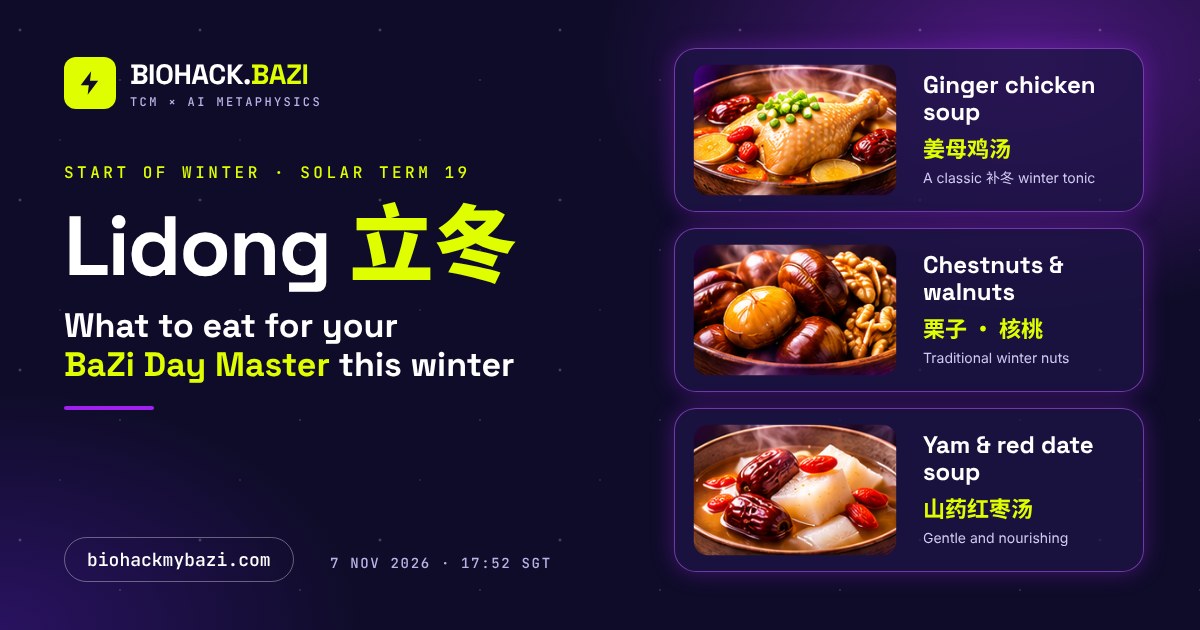
Short answer
What is Lidong?
立冬 (Lìdōng, "Start of Winter") is the 19th of the 24 Chinese solar terms. In 2026 it fell on 7 November and ran until 小雪 (Minor Snow) on 22 November. It marks the switch from the season of harvest to the season of 藏, storing. In the Five Elements, winter belongs to Water, the North, the colour black and, in TCM, the Kidney system. In BaZi, Lidong opens the 己亥 (Ji Hai) month, so the energy of your chart literally changes on this day.
The next Lidong falls on 7 November 2027, according to the Hong Kong Observatory 2027 calendar.
What does Lidong (立冬) mean?
The two characters tell the whole story. 立 (lì) means to establish or begin. 冬 (dōng) was explained by old calendar scholars as 终 (zhōng), the end: the point in the year when the harvest is in and everything is gathered and put away. The classical gloss in the Yueling Qishi'er Hou Jijie reads "冬,终也,万物收藏也": winter is the end, when all things are stored.
Ancient Chinese thinkers grouped the year into four motions: spring generates (生), summer grows (长), autumn harvests (收) and winter stores (藏). Lidong is the doorway into storing. That is the single most useful idea on this page. Winter is not a time to push harder. It is a time to conserve, consolidate and recharge so that you have something to spend when spring arrives.
水 · Element: Water
Depth, wisdom, stillness, flow
北 · 黑 · North · Black
The direction and colour of winter
肾 · TCM: Kidney system
Traditionally seen as the store of 精 (jing), core vitality
2026 record: The three pentads of Lidong (立冬三候)
The ancients split every solar term into three five-day "pentads", each named after something you could see in nature:
| Pentad | 2026 dates | Sign | What it says to you |
|---|---|---|---|
| 水始冰 | 7 to 11 Nov | Water begins to freeze | Slow down. Things are starting to set. |
| 地始冻 | 12 to 16 Nov | The earth begins to harden | Lock in your foundations and routines. |
| 雉入大水为蜃 | 17 to 21 Nov | Pheasants vanish; large clams appear in the sea | Transformation happens out of sight. Go inward. |
The third pentad is the most poetic. Ancient observers noticed pheasants disappearing and clams with similar stripes washing up, and concluded one had become the other. It is not biology, but it is a beautiful metaphor: winter is when you change quietly, below the surface.
How did Chinese emperors welcome winter (迎冬)?
Lidong was one of the 四立 (Four Beginnings), alongside the starts of spring, summer and autumn. For an emperor, whose title "Son of Heaven" made him the link between Heaven and the people, getting the seasons right was a political duty. Here is what the record shows.
ZHOU DYNASTY RITUAL · BOOK OF RITES (礼记·月令)
Three days of fasting, then a procession to the north.
Three days before Lidong, the Grand Astrologer announced to the Son of Heaven: "某日立冬,盛德在水", "On such a day winter begins; the great virtue now resides in Water." The emperor purified himself with fasting. On the day itself he personally led his three dukes, nine ministers and senior officials to the northern suburbs to welcome winter, because North is the direction of Water.
DRESSED FOR THE ELEMENT
Black carriage, black horses, black flags, black robes, dark jade.
The same text describes the emperor moving into the northern hall of the palace for winter, riding a dark carriage pulled by black horses, flying black banners and wearing black with dark jade. He ate pork and millet. Every detail was chosen to align the ruler, and therefore the realm, with Water.
COMPASSION AS RITUAL
Rewards for the fallen, care for orphans and widows.
After the ceremony, the emperor honoured families of those who had died in service and provided for orphans and widows (赏死事,恤孤寡). Winter began with an act of generosity, a detail worth copying.
HAN, WEI, TANG AND SONG DYNASTIES
The gift of warmth.
Later dynasties turned Lidong into a day of handing out warmth. Emperor Wen of Han is recorded giving padded coats to palace attendants and officials on Lidong. Emperor Wen of Wei had officials of every rank wear warm hats from this day. Under the Tang, the court received "thousand-layer socks" made from more than ten layers of silk. In the Song, officials got a day off on Lidong, there was "snow-cold money" when snow fell, and families put on new clothes and visited elders, a custom called 拜冬, "paying respects to winter".
And what ordinary people did
- 补冬 (bǔ dōng), "tonifying for winter": southern China and Taiwan still say "立冬补冬,补嘴空", roughly "at Lidong, nourish for winter and treat your mouth". Ginger duck and sesame-oil chicken are classic.
- Dumplings in the north: 饺子 (jiǎozi) sounds like 交子, "the meeting point", because Lidong is where autumn meets winter.
- Lamb in Shanghai, braised red in the north of the city and boiled white in the south.
- Ancestor offerings with newly harvested grain, and putting away farm tools until spring.
What did the legendary healers advise?
The Yellow Emperor (黄帝): "go to bed early, rise late"
The Huangdi Neijing (Yellow Emperor's Inner Classic), the founding text of Chinese medicine, is written as a dialogue between the legendary Yellow Emperor and his physicians. Its chapter on living with the four seasons gives the most quoted winter advice in Chinese history:
冬三月,此谓闭藏……早卧晚起,必待日光……去寒就温,无泄皮肤……此冬气之应,养藏之道也。
"The three months of winter are called closing and storing… Go to bed early and rise late; wait for the sunlight… Leave the cold and stay near warmth; do not let sweat drain through the skin… This is responding to the qi of winter: the way of nourishing storage." (素问·四气调神大论)
The same chapter warns that going against winter "harms the Kidneys", leaving you with less to draw on in spring. It also says to keep your intentions "as if hidden, as if concealed, as if you already have what you want". In modern terms: stop broadcasting your plans, and build quietly.
Sun Simiao (孙思邈): food first
Sun Simiao, the Tang-dynasty physician later revered as the "King of Medicine" (药王), devoted a whole section of his Qianjin Yaofang to 食治, food therapy. His view, still central to TCM, is that a good physician first adjusts diet and only then reaches for medicine. That is the spirit of every food suggestion below.
Zhang Zhongjing (张仲景) and the dumplings
A much-loved folk legend says the Han-dynasty physician Zhang Zhongjing, author of the Shanghan Lun (Treatise on Cold Damage), cooked mutton, chili and warming herbs inside dough shaped like ears to save villagers from frostbitten ears. Most tellings tie it to the Winter Solstice rather than Lidong, and historians treat it as legend, not record. It is still why many families eat dumplings as the cold arrives.
Li Bai (李白) and the warm wine
A short poem titled 立冬 is attributed to Li Bai (the attribution is debated): "冻笔新诗懒写,寒炉美酒时温", "my pen is frozen and I am too lazy to write new poems; by the cold stove I keep warming good wine." Even the greatest poet of the Tang gave himself permission to slow down.
The emperor aligned himself with the season. Do you know your own element?
Your Day Master decides whether winter's Water feeds you, pressures you or drains you. Find out in about 60 seconds.
What does Lidong change in your BaZi chart?
This is where Lidong stops being folklore and becomes practical. In BaZi (八字, Four Pillars), months do not start on the 1st. They start on the twelve "jie" (节) solar terms, and Lidong is one of them. At 17:52 on 7 November 2026 (Singapore and Beijing time), the month pillar switches from 戊戌 (Wu Xu) to 己亥 (Ji Hai).
己 · Heavenly Stem
Yin Earth · Fertile, wet field soil
亥 · Earthly Branch
Pig, Yin Water · Hidden stems 壬 Yang Water and 甲 Yang Wood
❄ · Season
Water rising · Lasts until 大雪 (Major Snow) on 7 December 2026
Three things follow from that:
- Water gets stronger for everyone. Whatever Water represents in your chart (support, pressure, money, creativity or competition) becomes louder for the next month and, as winter deepens, the next three.
- Cold charts need Fire. Classical BaZi texts such as the Qiongtong Baojian (穷通宝鉴) stress 调候 (tiáo hòu), "climate balancing": a chart full of winter Water usually benefits from warmth. This is one reason winter food and habits lean warm.
- Branch interactions switch on. 亥 clashes with 巳 (Snake), combines with 寅 (Tiger) and forms a Wood frame with 卯 (Rabbit) and 未 (Goat). See the alert below.
What is your Lidong plan by Day Master?
Your Day Master (日主) is the Heavenly Stem of your day pillar: the element that represents you in BaZi. Winter Water plays a different role for each one. Jump to yours:
WOOD (甲 Jia and 乙 Yi)
Winter Water is your Resource (印): support, learning, mentors, rest.
Water feeds Wood, so winter tends to feel nourishing. The catch: a tree in frozen soil cannot grow. Classical texts say winter Wood needs Fire (sunlight) to come alive.
- Lean into
- Courses, reading, planning 2027, asking a mentor for advice. Get outdoor morning light daily.
- Eat more
- Warm cooked greens with ginger and scallion, chestnuts, walnuts, a small amount of black sesame.
- Watch for
- Comfortable inertia: absorbing information without acting on it.
FIRE (丙 Bing and 丁 Ding)
Winter Water is your Officer / Seven Killings (官杀): pressure, deadlines, authority, discipline.
Water controls Fire, so winter is often your most demanding season. Expect more responsibility and scrutiny. Handled well, this is when Fire people earn promotions and respect.
- Lean into
- Structure: clear schedules, one priority a day. Lean on supporters (Wood people and mentors feed your Fire).
- Eat more
- Warming, cooked food: ginger tea, red dates, longan, cinnamon in moderation, slow soups. Cut iced drinks.
- Watch for
- Burnout and self-doubt. Sleep is non-negotiable for you this month.
EARTH (戊 Wu and 己 Ji)
Winter Water is your Wealth (财): money, deals, resources, results.
Earth controls Water, so winter traditionally brings money themes and opportunities. But wet, cold earth turns to mud, and the 2026 Lidong month is itself 己 Earth over 亥 Water: a lot of Earth and Water together. Warmth keeps you firm.
- Lean into
- Closing deals, collecting what you are owed, a clear 2027 budget. Say no to anything that spreads you thin.
- Eat more
- Warm, drying foods traditionally used for the Spleen: millet, pumpkin, Chinese yam, red dates, ginger. Less cold, raw and greasy food.
- Watch for
- Overcommitting financially and feeling heavy or sluggish.
METAL (庚 Geng and 辛 Xin)
Winter Water is your Output (食伤): expression, creativity, ideas, performance.
Metal produces Water, so winter is a season where your ideas want out: writing, teaching, launching, speaking. Output also drains you, and cold Metal is brittle. Spend energy on purpose.
- Lean into
- Publish, pitch, teach, create. Then protect recovery time like a meeting.
- Eat more
- Nourishing, warm and moist: cooked white radish, Chinese yam, almonds, lily bulb or white fungus soups with a little ginger.
- Watch for
- Sharp words you cannot take back, and running on empty.
WATER (壬 Ren and 癸 Gui)
Winter Water is your Companion / Rob Wealth (比劫): peers, confidence, competition.
This is your home season, so you will feel strong and social. If your chart already has lots of Water, the risk is excess: overflowing like a river in flood. Give the energy somewhere to go.
- Lean into
- Teamwork and networking, but with clear agreements. Channel energy into creating (Wood, your output).
- Eat more
- Warm, balanced meals. Go easy on very salty food, which tradition links to Water. Add warming spices to cool foods.
- Watch for
- Money leaking through friends, rivals or impulse spending.
Important: these are starting points. A weak Fire Day Master and a strong Fire Day Master need very different things in winter, and your useful element depends on the whole chart, your birth season and your current Luck Pillar. That is exactly what a full chart reading works out.
Get the version of this page written for you
Enter your birth date, time and city. We use true solar time to find your Day Master, its strength and the elements that balance you.
What foods do people eat on Lidong?
Traditional winter eating follows the Neijing's logic: keep warmth in, nourish what you have stored, and match the season's colour. Winter's colour is black, so dark foods have long been associated with the Kidney system. Here is a quick reference, framed as tradition rather than prescription:
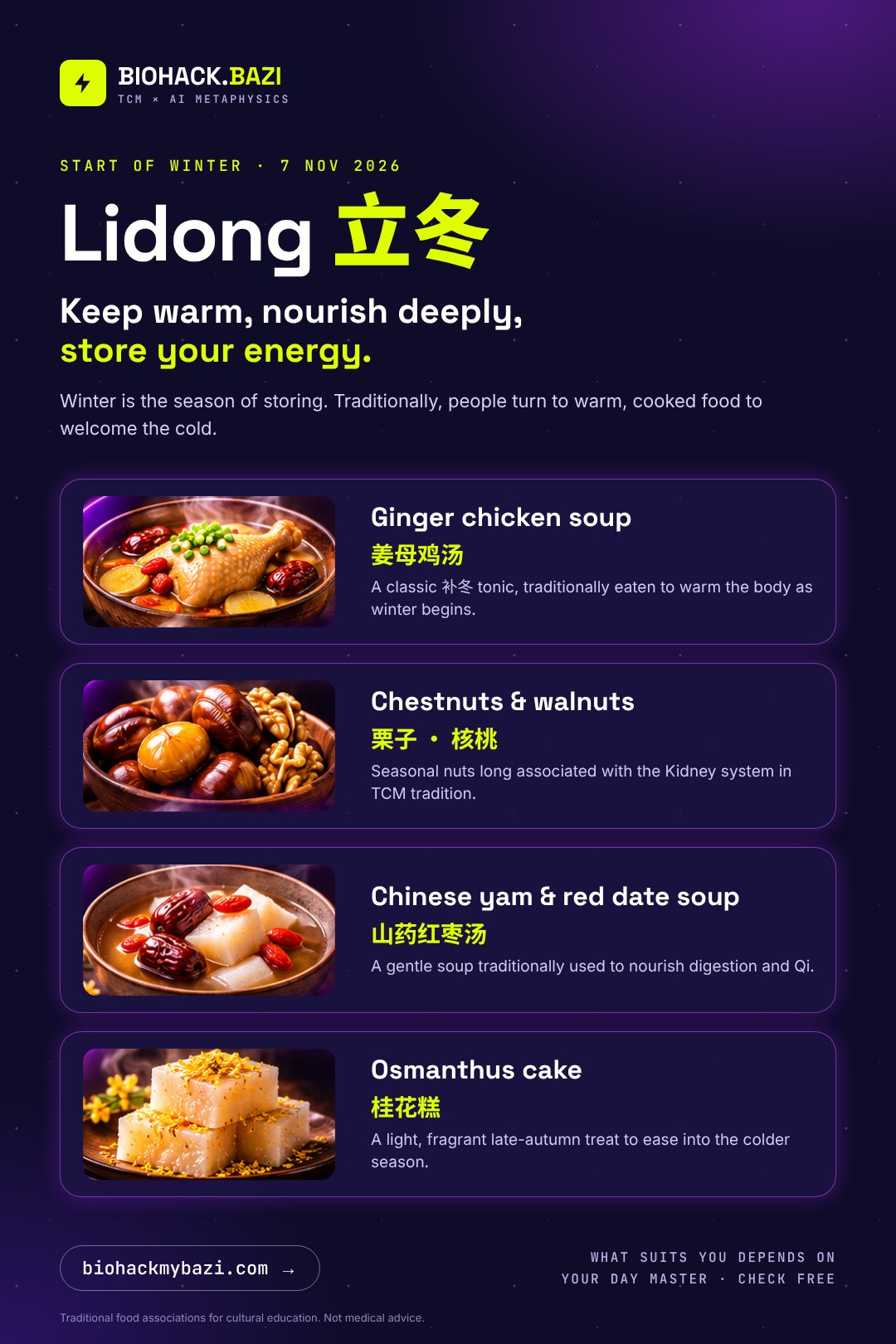
Swipe to see more →
| Food | Traditional nature | Why it is eaten in winter | Go easy if |
|---|---|---|---|
| Black sesame 黑芝麻 | Neutral | Classic "black food" for the Kidneys and hair | Loose stools |
| Black beans 黑豆 | Neutral | Black food, nourishing and filling | Bloating easily |
| Wood ear fungus 黑木耳 | Neutral | Black food, used in winter soups and stir-fries | Taking blood thinners (ask your doctor) |
| Walnuts 核桃 | Warm | Traditional winter nut for warmth and the lower back | You run hot or get mouth ulcers |
| Chestnuts 栗子 | Warm | Roasted at Lidong across China; "the fruit of the Kidneys" | Easily bloated |
| Chinese yam 山药 | Neutral | Gentle tonic for Spleen and Kidney | Very damp, heavy digestion |
| Lamb 羊肉 | Warm | The signature 补冬 dish in the north and Shanghai | You run hot, have acne or feel dry and thirsty |
| Ginger 生姜 | Warm | Disperses cold; base of ginger duck and teas | Hot, dry constitution |
| Red dates 红枣 | Warm | Everyday tonic in soups and teas | Damp heat, high blood sugar |
| Dumplings 饺子 | Depends on filling | The "meeting of seasons" food | Make fillings that suit your type |
Living somewhere hot? In Singapore, Malaysia and other tropical places, the "cold" most people meet is air-conditioning and iced drinks, and humidity is the bigger issue. Many families adapt 补冬 with lighter herbal soups instead of heavy lamb hotpot. Your TCM constitution matters more than the calendar here: someone with a damp-heat pattern and someone with a yang-deficient pattern should not eat the same winter menu.
Find your TCM body constitution and compare it with your Five Elements balance to see which foods are traditionally suggested for you.
What is a 15-day Lidong ritual anyone can follow?
Borrowed from emperors, physicians and farmers, adapted for modern life. Start on 7 November and keep going until Minor Snow on 22 November.
- STEP 1
Mark the moment.
At 17:52 on 7 November (Singapore/Beijing time), pause. Like the emperor's three-day fast, set one intention for winter: what will you store, protect or rebuild?
- STEP 2
Do a harvest review.
Write what 2026 gave you and what you will stop carrying. Storing starts with deciding what is worth keeping.
- STEP 3
Move bedtime 30 minutes earlier.
The Neijing's oldest winter rule: sleep early, rise with the light.
- STEP 4
Get morning sunlight.
"Wait for the sunlight" applies even in the tropics. Ten minutes outdoors helps your body read the season.
- STEP 5
Keep the lower back and feet warm.
Traditionally the Kidney area. Swap one iced drink a day for something warm and try a warm foot soak before bed.
- STEP 6
Eat one warm, dark-food meal a day.
Black sesame, black beans, wood ear, walnuts or chestnuts, adjusted to your constitution.
- STEP 7
Give warmth to someone.
Emperors gave coats and cared for orphans and widows. Send a care package, pay for a meal or check on an elder. Generosity at the start of a season is an old Chinese way of inviting good fortune.
- STEP 8
Keep plans quiet.
"As if hidden, as if concealed." Build your 2027 project privately and launch it in spring.
Your chart turns this ritual into a plan
See which element balances you, how the 己亥 month hits your four pillars, and what your Luck Pillar says about the season ahead.
Lidong FAQ
When is 立冬 (Lidong) in 2026?
Saturday 7 November 2026, at about 17:52 Beijing and Singapore time (09:52 UTC), when the sun reaches 225° of celestial longitude. The Lidong period lasts until 小雪 (Minor Snow) on 22 November 2026.
What does Lidong (立冬) mean?
立 means to begin and 冬 was read as 终, the end, when everything is harvested and stored. It is the 19th of the 24 solar terms and the start of winter in the Chinese calendar.
Does Lidong change the BaZi month?
Yes. BaZi months start at the "jie" solar terms, and Lidong opens the 亥 (Pig) month. In 2026 the month pillar is 己亥 (Ji Hai), running until 大雪 (Major Snow) on 7 December 2026. People born just before and just after Lidong have different month pillars, which is why accurate birth time and true solar time matter.
When is Lidong in 2027?
Lidong falls on 7 November 2027, according to the Hong Kong Observatory calendar. It marks the start of the winter season in the 24 solar terms.
What should I eat on Lidong according to TCM?
Warm, cooked, nourishing food: soups, stews, dark foods like black sesame, black beans and wood ear, plus walnuts, chestnuts, Chinese yam and ginger. Northern China eats dumplings; southern China and Taiwan keep the 补冬 tonic custom. Adjust to your constitution.
How should my Day Master adjust for winter?
Winter Water is the Resource for Wood, the Officer for Fire, Wealth for Earth, Output for Metal and the Companion for Water. Most charts born or living in deep winter also benefit from warmth (Fire). Your exact needs depend on your Day Master's strength, which the BaZi calculator works out.
Does 补冬 make sense in a tropical climate like Singapore?
In a modified form. Choose lighter tonic soups over heavy hotpots, watch for dampness, and treat air-conditioning and iced drinks as your "winter cold".
Biohack.BaZi content is for education and cultural reflection. It describes traditional Chinese frameworks and is not medical advice, diagnosis or treatment. BaZi interpretations are traditional associations, not guaranteed outcomes. If you are pregnant, take medication or have a health condition, speak to a qualified doctor or registered TCM practitioner before changing your diet. See how our methodology works.
Sources
- Hong Kong Observatory 2027 calendar
- 《礼记·月令》 Book of Rites, "Monthly Ordinances" (孟冬之月)
- 《吕氏春秋·孟冬》 and 高诱 commentary; 崔豹《古今注》; 陶谷《清异录》, as cited in Wenhui Bao, 7 Nov 2022
- 《黄帝内经·素问·四气调神大论》 Huangdi Neijing, Suwen, chapter 2
- 《月令七十二候集解》 on the meaning of 立冬 and its three pentads
- Fang Wei, Confucius Research Institute, "立冬:庭前木叶半青黄" (2023)
- China Daily, "Hot treats for cold comfort" (2022), on Song-dynasty Lidong customs
- National Astronomical Observatory of Japan almanac data and JPL Horizons ephemeris, for the 2026 solar term time