Article
Your Chart, Hidden Stems, Time Fixes: Heavenly Stems and Earthly Branches
Your Chart, Hidden Stems, Time Fixes: Heavenly Stems and Earthly Branches
The Heavenly Stems (10) and Earthly Branches (12) are two ordered Chinese sign sets that combine into a 60-pair sexagenary cycle used to name years, months, days, and double-hours. Together they form what practitioners call the Gan-Zhi system, the backbone of the traditional Chinese calendar and the framework behind BaZi (Four Pillars) analysis. Every birth moment, from year down to hour, gets tagged with one stem-branch pair.
TL;DR:
- The sexagenary cycle only repeats every 60 years because it pairs 10 stems with 12 branches, with a polarity rule limiting combinations to 60 valid pairs.
- Hidden stems within each branch can influence BaZi readings by adding elemental effects not visible from the zodiac animal alone.
- Precise birth time conversion, especially near double-hour boundaries, is essential for accurate BaZi analysis due to potential time zone and solar time adjustments.
- The cycle’s core structure has remained largely unchanged for over 3,000 years, surviving in Chinese, Japanese, and Korean traditions with minimal variation.
- Modern calculators automate the complex math, allowing individuals to generate accurate full charts with elemental and polarity insights using birth data.
Table of Contents
- The 10 Heavenly Stems and 12 Earthly Branches Explained
- How Does the 60-Year Sexagenary Cycle Actually Work?
- What Do the Elemental and Yin-Yang Associations Mean?
- How Are Stems and Branches Used for Years, Months, Days, and Hours?
- Why Do Hidden Stems and Birth Time Matter So Much?
- How Do You Read a Stem-Branch Pair Step by Step?
- Where Did the Heavenly Stems and Earthly Branches Come From?
- How Are Stems and Branches Used Beyond BaZi Charts?
- Do Chinese Holidays and Festivals Still Use This System?
- How Does This Compare to Japanese and Korean Zodiac Systems?
- A Modern Take on an Ancient Framework
- Get Your Personalized Stem-Branch Chart
- Sources
- FAQ
The 10 Heavenly Stems and 12 Earthly Branches Explained
The Heavenly Stems consist of 10 signs and the Earthly Branches consist of 12, and each set cycles independently before locking together into the larger sexagenary pattern. Think of them as two gears of different sizes turning at once. Learning their order is the first real step toward reading any stems and branches interpretation, whether you’re decoding a calendar date or your own BaZi chart.
The 10 Heavenly Stems, in sequence, are Jia (甲), Yi (乙), Bing (丙), Ding (丁), Wu (戊), Ji (己), Geng (庚), Xin (辛), Ren (壬), and Gui (癸).
The 12 Earthly Branches, in sequence, are Zi (子), Chou (丑), Yin (寅), Mao (卯), Chen (辰), Si (巳), Wu (午), Wei (未), Shen (申), You (酉), Xu (戌), and Hai (亥).
| Branch | Pinyin | Zodiac Animal | Double-Hour |
|---|---|---|---|
| 子 | Zi | Rat | Zi hour |
| 丑 | Chou | Ox | Chou hour |
| 寅 | Yin | Tiger | Yin hour |
| 卯 | Mao | Rabbit | Mao hour |
| 辰 | Chen | Dragon | Chen hour |
| 巳 | Si | Snake | Si hour |
| 午 | Wu | Horse | Wu hour |
| 未 | Wei | Goat | Wei hour |
| 申 | Shen | Monkey | Shen hour |
| 酉 | You | Rooster | You hour |
| 戌 | Xu | Dog | Xu hour |
| 亥 | Hai | Pig | Hai hour |
This branch-to-animal-to-hour mapping comes straight from traditional calendar references, and it’s worth memorizing if you plan to read charts regularly.
How Does the 60-Year Sexagenary Cycle Actually Work?
Ten stems and twelve branches don’t just add up. They interlock. The sexagenary cycle advances both sequences together, so each new term pairs the next stem with the next branch, and the whole pattern only returns to its starting point after sixty steps. That number isn’t arbitrary. Sixty is the least common multiple of 10 and 12, which is why the cycle can’t repeat any sooner.
Here’s the mechanism in practice:
- The first pair is Jia-Zi (甲子), stem one with branch one.
- The cycle proceeds Yi-Chou, Bing-Yin, Ding-Mao, and onward, each position sliding forward by one.
- Because 10 is even and 12 is even, a Yang stem can only ever land on a Yang branch, and a Yin stem only on a Yin branch.
- That polarity rule cuts the theoretical 120 combinations down to exactly 60 real ones.
- The final pair, sixty steps later, is Gui-Hai (癸亥), after which the cycle loops back to Jia-Zi.
Once you see the polarity constraint, combinations like Jia-Chou or Yi-Zi make sense as impossible pairings. They’d mix a Yang stem with a Yin branch, which the system simply doesn’t allow.
What Do the Elemental and Yin-Yang Associations Mean?
Tradition assigns each stem to one of the Five Elements (Wu Xing) in alternating Yang and Yin polarity: Jia and Yi correspond to Wood, Bing and Ding to Fire, Wu and Ji to Earth, Geng and Xin to Metal, and Ren and Gui to Water. Jia, Bing, Wu, Geng, and Ren are Yang. Yi, Ding, Ji, Xin, and Gui are Yin. That alternation is what gives every stem both an element and a charge.
The branches carry their own layered meanings beyond the zodiac animal:
- Each branch links to a double-hour, as shown in the table above.
- Seasonal groupings cluster branches into spring, summer, autumn, and winter blocks of three.
- Directional associations tie branches to compass sectors used in Five Elements and Feng Shui work.
- These correspondences matter because a BaZi reading weighs elemental balance across a whole chart, not just one animal sign.
Skip the elemental layer and you’re left with a zodiac curiosity. Include it, and you have an actual interpretive tool.
How Are Stems and Branches Used for Years, Months, Days, and Hours?
Every unit of traditional time gets its own stem-branch pair, and the rules for assigning them differ slightly by unit.
- Years rotate through the 60-term cycle, but the Chinese New Year date doesn’t always match the astrological Lichun (start of spring), so a birth in late January or early February can fall into a different year pillar than the lunar calendar suggests.
- Months are fixed to branches based on the solar calendar’s twelve segments, with stems assigned through a formula tied to the year stem.
- Days continue an unbroken sexagenary count that has run for centuries, independent of month or year boundaries.
- Double-hours (shichen) assign a branch to each two-hour block of the day, with the stem determined by the day’s own stem.
Stack all four together, year, month, day, and hour, and you get the Four Pillars, or Eight Characters (BaZi). That’s the full natal chart practitioners read for elemental balance, personality themes, and life pattern analysis. It’s the same Gan-Zhi math used on a calendar page, just applied four times over to one birth moment.
Why Do Hidden Stems and Birth Time Matter So Much?
Basic guides list one animal per branch and stop there. Real BaZi work goes deeper. Each Earthly Branch contains hidden stems, secondary stems tucked inside it that carry their own elemental weight and can shift a chart’s balance considerably. A branch that looks like pure Earth on the surface might be quietly leaking Fire or Water underneath, depending on which hidden stem dominates.
Birth time precision is the other trap. Double-hour ranges are traditional two-hour blocks, but converting a civil clock time into the correct shichen sometimes requires adjusting for true solar time rather than the time zone on your birth certificate. A birth near a shichen boundary, say 12:55 PM instead of clearly inside the Wu hour, can flip which pillar applies entirely.
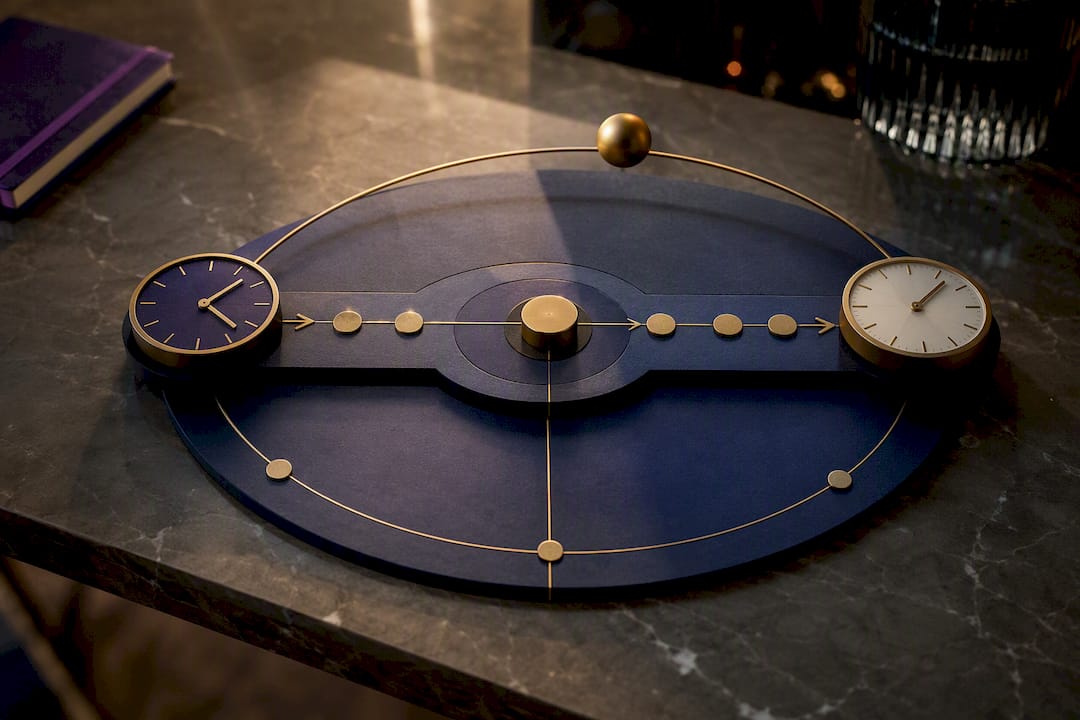
Pro Tip: If your birth time sits within 15 minutes of a double-hour boundary, or you’re unsure of your exact time zone at birth, run your details through a calculator built to handle longitude correction rather than eyeballing a standard hour chart.
How Do You Read a Stem-Branch Pair Step by Step?
Reading one pair is simpler than it looks once you know the order of operations.
- Locate the date or time you want to analyze and find its stem-branch pair using a calendar reference or calculator.
- Identify the stem’s element and polarity (Wood, Fire, Earth, Metal, or Water; Yang or Yin).
- Note the branch’s zodiac animal and double-hour, then check its hidden stems if you’re going beyond a surface reading.
- Count how often each element appears across all four pillars to spot an excess or a gap.
- If two or more elements are wildly imbalanced, or your birth time is uncertain, verify the chart with a dedicated BaZi calculator rather than hand-counting.
Small details move outcomes here. A wrong time zone, a birth time rounded to the nearest half hour, or an ignored hidden stem can each shift the reading enough to change the interpretation entirely.
Where Did the Heavenly Stems and Earthly Branches Come From?
The system is old, older than most people assume when they first encounter it in a modern wellness context. Oracle-bone inscriptions from the Shang dynasty attest to stems being used as day names, which places the practice at least 3,000 years back, long before anyone had attached zodiac animals or elemental theory to it.
That’s a detail worth sitting with. The stems started as a practical day-counting device, a way for Shang-era record keepers to track ritual and administrative dates without ambiguity. The branches likely joined the system as calendrical markers in their own right, tracking months and later hours, and the zodiac animal layer came afterward as a cultural attachment rather than an original feature. The pairing into a full sexagenary cycle for years came later still, evolving through the Han dynasty and after as calendrical science matured.
What’s notable is how little the core mechanism has changed. The same ten stems and twelve branches that named days on turtle shells and ox bones still name days on calendars used across East Asia. Continuity across three millennia is rare for any human system, let alone one still functioning as intended. Modern BaZi practice, oddly enough, is closer to a straight-line descendant of Shang-era timekeeping than most other surviving ancient frameworks.
How Are Stems and Branches Used Beyond BaZi Charts?
BaZi gets the most attention, but the Gan-Zhi system runs quietly through several other corners of Chinese metaphysics and traditional practice.
Feng Shui practitioners use the branches’ directional and seasonal associations to orient buildings, rooms, and furniture placement, treating the twelve branches as compass sectors layered onto physical space. A home’s entrance facing a branch linked to a clashing element, for instance, might prompt a practitioner to recommend specific placement adjustments.
Traditional Chinese medicine draws on the same elemental logic that underpins the stems. Since Jia and Yi map to Wood, and Wood in TCM theory governs the liver and gallbladder systems, practitioners sometimes fold stem-based elemental timing into broader constitution assessments. This is where the stems-and-branches framework overlaps with the Five Elements and TCM constitution model that connects calendar theory to lifestyle and wellness themes.
Date selection, choosing an auspicious day for a wedding, a business opening, or a burial, also leans on Gan-Zhi calculations.
None of these applications require abandoning the calendrical core. They’re extensions of the same 60-term logic, applied to space, body, and timing decisions instead of just tracking years and days.
Do Chinese Holidays and Festivals Still Use This System?
Yes, and more visibly than most people realize. The Chinese New Year itself marks the transition from one year’s stem-branch pair to the next, which is why you’ll hear a year described as “the Year of the Wood Dragon” or “the Year of the Fire Snake” rather than just an animal name. That full description combines the year’s stem element with its branch animal.
Almanac-based festivals depend even more directly on the system. The Qingming Festival and other solar-term observances are pinned to the same calendrical structure that assigns branches to months, since the twelve months line up with recurring seasonal branch positions. Wedding date selection, a near-universal practice in Chinese communities, routinely involves consulting an almanac for days whose stem-branch elements complement the couple’s own charts.
Even outside formal festivals, everyday practice keeps the system alive. Many households still check the daily almanac listing, complete with its stem-branch designation and associated auspicious or inauspicious activities, before scheduling a move, a haircut, or a major purchase. The Gan-Zhi cycle isn’t a museum piece confined to old calendars. It’s functioning infrastructure behind holidays, life events, and daily decisions across the Chinese-speaking world.
How Does This Compare to Japanese and Korean Zodiac Systems?
Japan and Korea both inherited the Gan-Zhi framework from Chinese calendrical tradition, and both adapted it in ways that reveal how flexible the underlying structure really is.
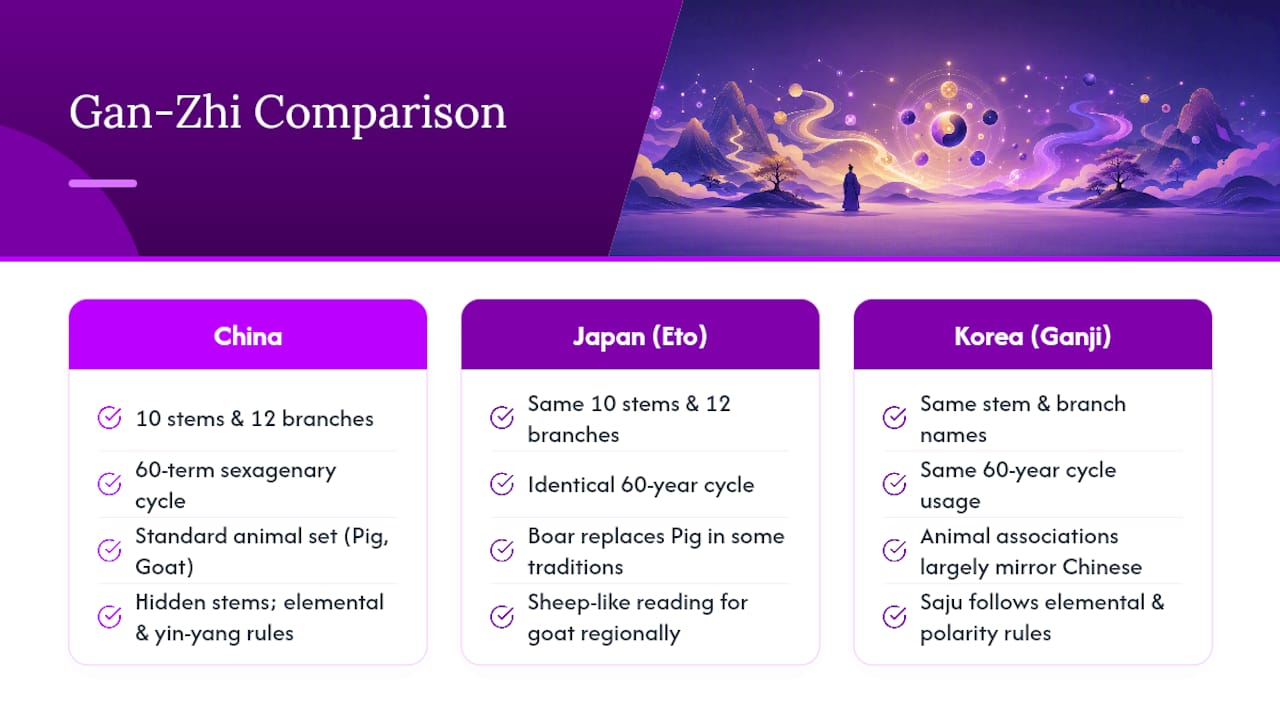
Japan’s Eto system uses the same 10 stems and 12 branches, producing an identical 60-year cycle, and the animal associations largely mirror the Chinese set with one well-known swap: the Boar takes the place some traditions assign to the Pig, and Japan’s zodiac substitutes a sheep-like reading for the goat in certain regional interpretations. Japanese culture also historically used the sexagenary cycle for era-naming and calendar dating well into the Meiji period, before the Gregorian calendar took over for civil use.
Korea’s Ganji system is closer still to the Chinese original, retaining the same stem and branch names in Korean pronunciation and using the cycle for the same year, month, day, and hour applications. Korean fortune-telling practices, particularly Saju (Korea’s version of BaZi), follow nearly identical elemental and polarity rules to their Chinese counterpart, right down to the hidden stems concept inside each branch.
What stands out across all three cultures is how little drift occurred despite centuries of separate development. The sixty-term structure, the elemental mapping, and the yin-yang polarity rule all survived transmission largely intact. That’s a strong signal the underlying math, ten and twelve sharing a least common multiple of sixty, was robust enough that no culture found a compelling reason to change it.
A Modern Take on an Ancient Framework
Timekeeping and self-reflection aren’t as far apart as they seem. A system built to track days on oracle bones evolved into a tool for reading personality and constitutional tendencies, and that arc makes sense once you realize both applications rest on the same elemental logic. Digital calculators haven’t replaced the tradition; they’ve made it more exact, handling hidden stems and true solar time conversions that used to require years of practitioner training to get right. This approach builds on the principle of precision first, so the interpretation that follows actually holds up.
— Biohack
Get Your Personalized Stem-Branch Chart
Reading someone else’s stem-branch table is one thing. Seeing your own Four Pillars laid out, with hidden stems accounted for and your birth time properly converted, is a different experience entirely. A free BaZi calculator handles the sexagenary math automatically, including the shichen conversion details that trip up manual calculations, and generates a downloadable chart in Mandarin and English.

Instead of cross-referencing stem tables and double-hour charts by hand, you enter your birth date, time, and location once. The calculator returns your full stem-branch breakdown across all four pillars, along with a look at your elemental balance and TCM constitution themes. If you want the conceptual grounding first, What Is BaZi? A Beginner’s Guide to the Four Pillars walks through how the pillars connect before you generate your own. Either way, start by running your birth details through the calculator to see your actual chart rather than a generic example.
Sources
- Heavenly Stems and Earthly Branches|Hong Kong Observatory(HKO)|Calendar
- Sexagenary cycle - Wikipedia
- Heavenly Stems & Earthly Branches - Calendar - Travel China Guide
- Chinesezodiac
- Academic overview of stems/branches history (IU ScholarWorks)
FAQ
What Is the Difference Between Heavenly Stems and Earthly Branches?
Heavenly Stems are a set of 10 signs tied to the Five Elements and yin-yang polarity, while Earthly Branches are a set of 12 signs linked to zodiac animals, double-hours, and seasons. Together they form paired terms in the 60-year Gan-Zhi cycle.
Why Are There 60 Combinations Instead of 120?
Ten and twelve share a least common multiple of 60, and a yin-yang polarity rule blocks any pairing where a Yang stem meets a Yin branch or vice versa, which cuts the mathematically possible 120 combinations down to exactly 60 valid ones.
What Are Hidden Stems in BaZi?
Hidden stems are secondary stems contained within an Earthly Branch that carry their own elemental influence, and accurate BaZi analysis accounts for them rather than relying on the branch’s animal label alone.
Can I Calculate My Own Stem-Branch Pairing?
Yes. A free BaZi calculator generates your full stem-branch pairing across all four pillars using your birth date, time, and location, including the shichen and solar-time adjustments that manual charts often miss.
Are Heavenly Stems and Earthly Branches Only Used in China?
No. Japan’s Eto system and Korea’s Ganji system both use the same 10 stems and 12 branches for an identical 60-year cycle, with only minor regional variations in animal naming and pronunciation.
Recommended
- What Are the Four Pillars of BaZi?
- What Is a BaZi Day Master?
- How to Read a BaZi Chart: A Beginner’s Guide