Article
84% Accuracy and the Mindset Gap: AI in Wellness, TCM, and BaZi
84% Accuracy and the Mindset Gap: AI in Wellness, TCM, and BaZi
AI in wellness now personalizes coaching, interprets wearable data, and scales one-on-one guidance to millions of people at once. The catch: results depend heavily on validated models, transparent reasoning, and a human somewhere in the loop. Systems like the agentic wearable-data agent PHIA and Stanford’s LLM coach Bloom show real promise, but they also show exactly where the evidence still runs thin.
TL;DR:
- AI wellness tools currently excel at interpreting wearable data with around 84% accuracy, but their impact on actual health outcomes remains unproven.
- Most research shows AI shifts user mindset and perception more reliably than it increases measurable physical activity or health metrics.
- Traditional Chinese Medicine applications using AI can assist in pattern recognition and knowledge expansion but face challenges due to inconsistent data standards and regional variations.
- Consumer safety depends on human oversight, transparency, and clear scope, as AI tools are not intended to replace clinical judgment or emergency care.
- Selecting reliable AI wellness tools requires evidence of validation, explainability of recommendations, strong data privacy policies, and realistic scope for reflection rather than treatment.
Table of Contents
- What Is AI in Wellness Actually Used For Right Now?
- How Accurate Is AI at Reading Health Data?
- Can AI Improve Traditional Medicine Practices Like TCM?
- Is It Safe to Use AI Wellness Tools?
- How Do You Choose the Right AI Wellness Tool?
- Biohack.BaZi’s Approach to AI-Assisted Self-Reflection
- What Rules Govern AI in Health and Wellness Apps?
- Where Do Biases Show Up in AI Wellness Tools?
- Is AI in Wellness Accessible to Everyone?
- What Comes Next for AI in Wellness?
- The Real Signal Buried in the Research
- Try Your Free AI-Assisted BaZi Chart Today
- Sources
- FAQ
What Is AI in Wellness Actually Used For Right Now?
AI in wellness spans four distinct categories today, and mixing them up is where most confusion starts. A chatbot that reflects your mood back to you is not the same species of tool as an agent that reads six months of your sleep data and flags a trend. Understanding which bucket a tool falls into is the first step to judging whether it can actually help you.
LLM-based personal coaching is the most visible category. These tools use motivational interviewing techniques borrowed from behavioral psychology, structured onboarding interviews, and long-term memory to track your goals across weeks or months. The better-designed ones use dialog-state scaffolding, meaning the conversation follows a script behind the scenes so the AI stays on topic instead of drifting into generic chitchat or unsolicited advice. Stanford’s Bloom coaching app is a research example of this design pattern in action.
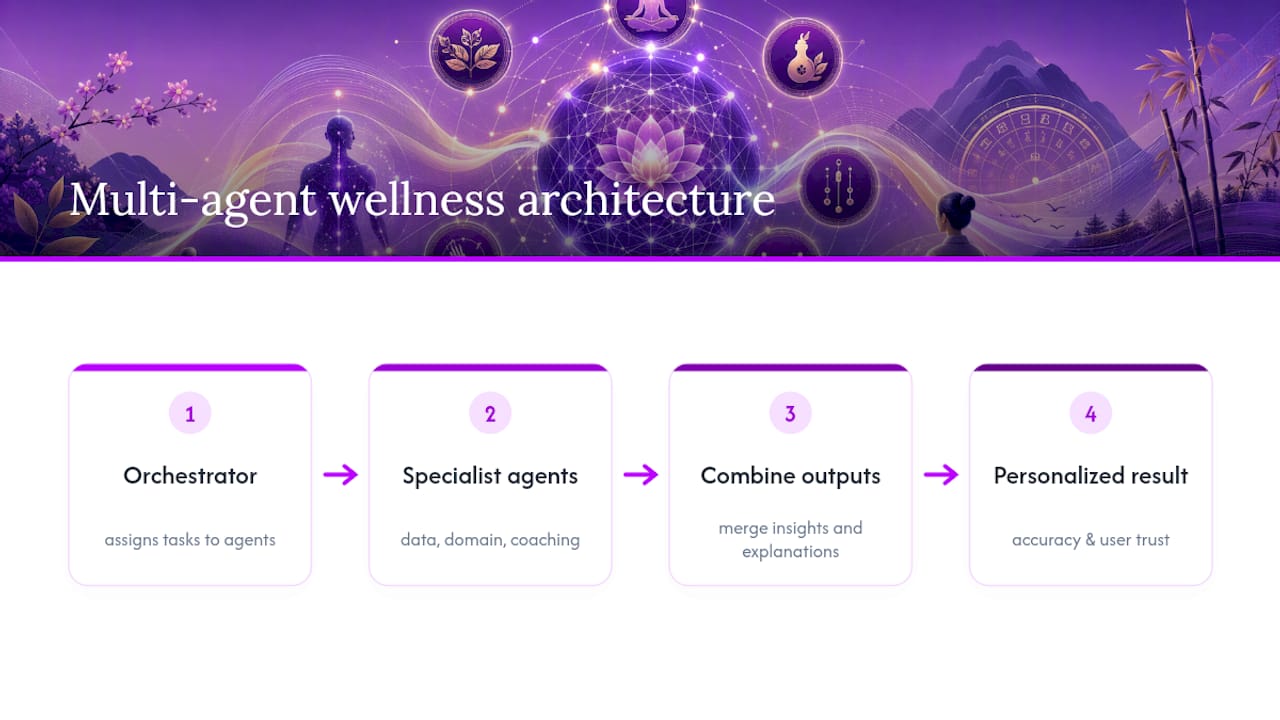
Agentic wearable-data systems work differently. Instead of just chatting, they act like a data analyst working on your behalf: writing code to parse time-series data from your fitness tracker, cross-referencing sleep and heart-rate patterns, and synthesizing a plain-language summary. Google researchers describe this as a multi-agent architecture, where an orchestrator assigns tasks to specialist agents. One handles data science, one handles domain expertise, and one handles the actual coaching conversation. That division of labor, according to Google’s personal health agent research, improves both accuracy and clinician trust compared to a single all-purpose model trying to do everything at once.
Corporate wellness programs apply AI at a population level. Instead of a single user’s chart, employers get aggregated engagement analytics, personalized nudges (a reminder to move after three hours of inactivity, a suggestion to try a specific stress exercise based on survey responses), and predictive flags for burnout risk across teams. The upside is scale. The risk is that population-level personalization can flatten individual nuance if the underlying data set skews toward one demographic.
Mental-health chatbots occupy the most sensitive tier. These tools offer support, mood tracking, and light triage, pointing a user toward crisis resources when language suggests escalating risk. They are not therapists, and the American Psychological Association’s advisory on generative AI chatbots is explicit that these tools have real limits around consumer safety and clinical judgment.
Here’s how the four categories break down in practice:
- Personal LLM coaches: build habits through conversation, memory, and motivational framing rather than raw data crunching.
- Wearable-data agents: pull and interpret device data (sleep, heart rate, steps) and generate insight reports, often using code execution behind the scenes.
- Corporate wellness platforms: apply machine learning in fitness and health analytics across an employee population for engagement and risk flagging.
- Mental-health chatbots: offer conversational support and initial triage, with built-in referral pathways to human clinicians.
A small but telling case: PHIA, the wearable-data agent studied in Nature Communications, was evaluated across 650 hours of human expert review specifically because raw accuracy on numbers is not the same as producing useful, trustworthy insight. That distinction runs through nearly every serious study of AI wellness analysis published so far.
How Accurate Is AI at Reading Health Data?
PHIA hit 84% accuracy on objective, numerical wearable-tracking questions during that 650-hour expert evaluation, and it earned strong quality ratings even on open-ended reasoning questions where there is no single correct answer. That is a meaningfully high bar for a system parsing messy time-series data from consumer devices, and it suggests agentic architectures are getting genuinely good at the mechanical work of pattern detection.
But accuracy on data interpretation is a different claim than proof of health improvement, and this is where a lot of marketing copy quietly blurs the line.
Statistic Callout: PHIA reached 84% accuracy on objective wearable-tracking questions, based on a large-scale human expert evaluation, according to research published in Nature Communications.
Stanford’s Bloom study makes the distinction concrete. Researchers found that people using the LLM-powered coaching app reported real shifts in mindset: physical activity felt more achievable, and users perceived greater benefit from moving their bodies. That is not nothing. Mindset shapes adherence, and adherence is usually the actual bottleneck in fitness and wellness goals, not motivation in the abstract. Yet the study also found that measured activity levels increased at a similar rate to a non-LLM comparison group over the study period. The AI changed how people felt about moving more than it changed how much they actually moved.
That gap between subjective mindset and objective behavior shows up across the research pool, and a few limitations explain why:
- Sample sizes tend to be modest. Most published AI wellness studies involve dozens to a few hundred participants, not the tens of thousands needed to detect small effect sizes reliably.
- Follow-up periods are short. Weeks of data, not years, which makes it hard to know whether a mindset shift compounds into a durable habit or fades once the novelty wears off.
- External validation is uneven. Many results come from the same team that built the tool, which is a normal first step in research but not a substitute for independent replication.
- Confounders are hard to isolate. People who opt into an AI coaching trial are often already more motivated than average, which can inflate perceived benefits.
The honest evidence grade, as of now: strong for data interpretation accuracy, moderate for engagement and mindset effects, and preliminary for durable, objective health outcomes. Anyone shopping for an AI wellness analysis tool should treat those as three separate questions, not one.
Can AI Improve Traditional Medicine Practices Like TCM?
AI is accelerating parts of Traditional Chinese Medicine research and practice, particularly in formula design, ingredient screening, and the digitization of centuries of clinical documentation, but full clinical translation is still limited by data standardization gaps. That is the honest state of AI in traditional medicine right now: genuinely useful acceleration in specific technical tasks, paired with real structural barriers to broader clinical trust.
Concrete use-cases already in motion include:
- Knowledge graphs that map classical TCM terminology to modern biomarkers, making it possible for a model to connect a term from a centuries-old text to a measurable, modern clinical feature.
- Formula recommendation systems that suggest herbal combinations based on pattern-matching across historical case records and known ingredient interactions.
- Active-ingredient screening, where machine learning shortens the search for which compounds within a traditional formula are doing the therapeutic work, a use documented in TCM R&D research published via SpringerLink.
- Tongue and pulse image interpretation, using computer vision to support the visual diagnostic methods TCM practitioners have used for generations.
- Documentation digitization, converting handwritten clinical records and classical texts into structured, searchable data sets.
The technical engine behind all of this is a combination of multimodal data fusion (combining image, text, and structured data), domain-specific knowledge graphs, and increasingly, domain-tuned language models trained specifically on TCM terminology rather than general medical text. A PMC review of AI applications in TCM describes this knowledge-graph work as one of the more mature technical enablers currently in use.
The barriers are just as real as the progress. TCM data is not standardized the way modern clinical trial data is; the same symptom pattern can be described in a dozen dialectal or historical variants across different texts and regions. Data quality varies enormously depending on the source, cultural context shapes how symptoms and constitutions get described, and without careful design, a model trained on one regional tradition can carry that bias into recommendations for someone from a different tradition entirely. External validation, as the Frontiers review on AI in traditional medicine points out, remains one of the biggest open needs before these tools earn broad clinical trust.
This is precisely the space Biohackmybazi occupies, and deliberately so: as an educational, self-reflection tool that uses AI to interpret BaZi elemental charts and TCM constitution themes, not as a diagnostic or treatment platform. If you’re exploring what happens when BaZi, TCM, and AI meet, the honest framing matters: these insights are a starting point for self-understanding, and any actual health concern belongs with a licensed practitioner, not a chart.
Is It Safe to Use AI Wellness Tools?
AI wellness tools are safe enough for low-stakes personalization and reflection, but the APA’s advisory on generative AI chatbots and wellness apps draws a firm line: these tools are not equipped to replace clinical judgment, and consumer safety depends on knowing exactly where that line sits. The advisory specifically calls out triage limits, meaning a chatbot can flag concerning language, but it should never be the last stop before a person in crisis reaches help.
Explainable AI, often shortened to XAI, is quickly becoming a non-negotiable design requirement rather than a nice extra. Clinicians and informed users increasingly want to see the reasoning behind a recommendation, not just the recommendation itself. A health-tech perspective published in AJMC frames this shift as case-based reasoning replacing black-box outputs: an AI wellness tool should be able to show its work, not just assert a conclusion.
Human-in-the-loop oversight remains the safeguard that ties everything else together. In practice, this means:
- Route anything resembling a clinical or crisis signal to a human, whether that is a licensed therapist, a physician, or a designated escalation contact.
- Audit model outputs on a schedule, not just at launch. AI wellness tools can drift as usage patterns shift, and a model that performed well in testing can degrade quietly over months.
- Monitor for demographic drift, checking whether accuracy or recommendation quality holds steady across different user groups rather than skewing toward whichever population dominated the training data.
- Publish clear scope statements telling users explicitly what the tool is for (reflection, tracking, general coaching) and what it is not for (diagnosis, treatment, crisis intervention).
On privacy, a workable checklist looks like this: obtain clear, specific consent before collecting sensitive health data, collect only what the tool actually needs (data minimization), compartmentalize sensitive categories like mental-health data separately from general fitness data, store everything with strong encryption, and monitor for data drift that could signal a security or bias issue emerging over time.
Pro Tip: Before trusting any AI wellness score or recommendation, ask whether the company has published even a summary of its validation methodology. A tool that can explain how it was tested is a different category of product than one that only shows you a polished result.
Regulators and reviewers alike are pushing toward external validation, transparent performance metrics, and fairness audits as the baseline expectation for any AI wellness in fitness or mental health, not the exception.
How Do You Choose the Right AI Wellness Tool?
Choosing well starts with matching the tool’s actual scope to your actual need, then checking whether the company backs its claims with evidence you can verify. Best biohacking apps and wellness platforms vary wildly in rigor, and the difference is rarely obvious from the marketing page alone.
For individuals, run through this before you commit:
- Evidence: Has the underlying model or method been described in a published study, or is “AI-powered” the entire pitch?
- Explainability: Can the tool show you why it made a specific recommendation, not just what the recommendation is?
- Privacy: Is there a clear, readable policy on what data gets collected, stored, and shared?
- Interoperability: Does it connect cleanly with the wearables or health records you already use, or does it demand a separate silo?
- Scope clarity: Does the product clearly say it’s a coaching or reflection tool rather than implying clinical authority it doesn’t have?
Employers evaluating a company-wide rollout need a different, heavier checklist:
- Population-level validation: Was the tool tested on a group demographically similar to your actual workforce, not just a narrow pilot cohort?
- Data governance: Who owns the aggregated data, and what happens to it if the vendor relationship ends?
- Opt-in and opt-out flows: Can employees decline participation without any professional or reputational cost?
- Escalation pathways: Is there a documented, working connection between the AI tool and your existing employee assistance program or benefits provider?
- Integration: Does the platform fit into existing HR and benefits systems, or does it become another disconnected dashboard nobody checks?
When you get a vendor on a call, four questions separate serious companies from marketing shells: What was the study design behind your accuracy claims? What data sets trained your model, and how diverse are they? How do you monitor for performance drift after launch? And is there any clinician oversight built into escalation paths?
Red flags worth walking away from: vague claims of “clinically proven” results with no citation, no stated data sources, refusal to explain how recommendations are generated, and no visible path to human support when a user needs it. A reasonable minimum bar for any pilot program is a defined success metric, a fixed evaluation window, and a built-in exit clause if the tool underperforms.
Biohack.BaZi’s Approach to AI-Assisted Self-Reflection
Biohackmybazi built its platform around a specific, narrower promise: help you understand your elemental blueprint and TCM constitution themes through AI-assisted interpretation of your BaZi chart, not to diagnose or treat anything. That distinction matters given everything covered above about scope clarity and honest evidence grading.
The process itself is straightforward. You provide your birth date, time, and location, and the platform calculates your Four Pillars of Destiny chart, then uses AI to translate the traditional elemental patterns into plain-language reflections on your energy balance and constitution tendencies. You can explore your results interactively, download a Mandarin and English PDF report, and optionally explore tongue-image input as an additional layer of TCM constitution context. It’s designed as a starting point for self-reflection, in the same spirit as the TCM body constitution framework that maps nine traditional constitution types.
What Biohackmybazi does not claim is equally important. This is a self-reflection and personalization tool, built for curiosity and pattern recognition, not a diagnostic instrument. If a chart highlights a constitution tendency toward, say, dampness or deficiency patterns and that resonates with an actual physical symptom you’re experiencing, the right next move is a conversation with a licensed practitioner, not a deeper read of your chart. Used that way, AI-assisted BaZi analysis becomes a genuinely useful mirror: a way to notice patterns in your energy, mood, and habits that you might otherwise miss, paired responsibly with real clinical care when something needs it.
What Rules Govern AI in Health and Wellness Apps?
Regulation of AI in wellness is still catching up to the technology, and that gap is exactly why self-regulation and transparent design matter so much right now. Wellness apps that avoid explicit medical claims (diagnosis, treatment, cure) generally fall outside the strictest medical-device regulatory categories in most jurisdictions, which is precisely why so many products market themselves carefully as “coaching” or “reflection” tools rather than health interventions.
That regulatory gray zone puts more responsibility on the companies themselves. Compliance-minded AI wellness products typically publish clear scope statements distinguishing wellness support from clinical care, disclose their data practices in accessible language rather than dense legal text, and build in referral pathways to licensed professionals for anything resembling a medical or mental-health concern. The APA’s advisory functions as one of the clearest professional guidance documents currently available, even though it is not binding law.
For readers evaluating any AI wellness in fitness or mental health, checking whether a company acknowledges this regulatory gray zone honestly, rather than pretending regulatory approval it doesn’t have, is itself a meaningful signal of trustworthiness.
Where Do Biases Show Up in AI Wellness Tools?
Bias in AI wellness tools usually traces back to training data that overrepresents one demographic, one body type, or one cultural framework for understanding health. A model trained mostly on data from one population can misread signals or under-serve users outside that population, whether the issue is skin-tone bias in wearable optical sensors or cultural assumptions baked into how a chatbot interprets emotional language.
In traditional medicine contexts specifically, bias can also mean flattening regional or dialectal variation in how symptoms and constitutions get described, treating one tradition’s framework as the universal standard.
Mitigation strategies that actually help include training on demographically diverse data sets from the start, running fairness audits that specifically check performance across different groups rather than only in aggregate, and building feedback loops where users can flag when a recommendation feels off-base for their situation. Companies that publish even summary-level fairness testing results are doing more than most, and that transparency is worth rewarding as a consumer.
Is AI in Wellness Accessible to Everyone?
Accessibility in AI in wellness spans more ground than screen readers and captions, though those basics still get overlooked more often than they should. Real inclusivity means a tool works whether someone has limited data literacy, a disability, limited English proficiency, or simply doesn’t own the latest wearable device the system was designed around.
Practical inclusivity features worth looking for include multilingual support, voice-based interaction for users who find typing difficult, compatibility with a range of budget and premium wearables rather than a single brand, and interface design that doesn’t assume a high level of technical comfort. Cost matters too. Freemium models, where a meaningful core experience is genuinely free and premium features are optional rather than gatekeeping, tend to serve a broader range of people than subscription-only products.
Cultural inclusivity deserves equal weight. A wellness tool built entirely around Western biomedical assumptions can feel alienating, or simply inaccurate, to someone whose framework for understanding health draws on TCM, Ayurveda, or another tradition entirely. Tools that make room for multiple wellness paradigms, rather than treating one as the default and others as niche, tend to serve a genuinely global audience better.
What Comes Next for AI in Wellness?
The next wave of AI in wellness is moving toward multi-agent systems, deeper personalization through long-term memory, and tighter integration between traditional and modern health frameworks. The orchestrator-plus-specialist-agent architecture already used by systems like PHIA is likely to become the default design pattern, since splitting data analysis, domain expertise, and coaching conversation across specialized agents consistently outperforms single-model systems on both accuracy and user trust.
Expect continued growth in AI for self-reflection tools that blend modern data science with traditional frameworks, from TCM constitution analysis to other culturally rooted wellness systems, as demand grows for personalization that goes beyond generic step counts and calorie targets. Explainable AI will keep moving from a research nicety to a baseline product expectation, driven by both clinician demand and, eventually, regulatory pressure. And as knowledge-graph and multimodal data techniques mature, the gap between what AI can interpret and what it can meaningfully explain should continue narrowing, which is the real prerequisite for any of these tools earning genuine clinical trust down the line.
The Real Signal Buried in the Research
The most overlooked finding in this entire body of research isn’t the accuracy number. It’s the mindset gap. Stanford’s Bloom study shows people feel meaningfully different about their health after AI coaching while their measured behavior barely moves faster than a control group. That’s not a failure. It’s a clue about what these tools are actually good for right now: shifting how you relate to your own data and habits, not manufacturing outcomes independent of your effort.
Conventional wellness marketing sells AI as a shortcut to results. The research says something more honest and, frankly, more useful: AI in wellness works best as a mirror and a translator, turning scattered data or dense traditional frameworks into something you can actually reflect on. Readers should prioritize tools that are explicit about that role rather than ones promising outcomes the evidence doesn’t yet support. Pair AI-generated insight, whether from a wearable agent or a BaZi chart, with your own judgment and, when health is genuinely at stake, a licensed professional.
— Biohack
Try Your Free AI-Assisted BaZi Chart Today
There are AI wellness tools that offer a free entry point with no wearable required or subscription needed to unlock initial insights. All it takes is your birth date, time, and location to generate a personalized elemental chart and AI-assisted TCM constitution read, ready to explore right on the screen.
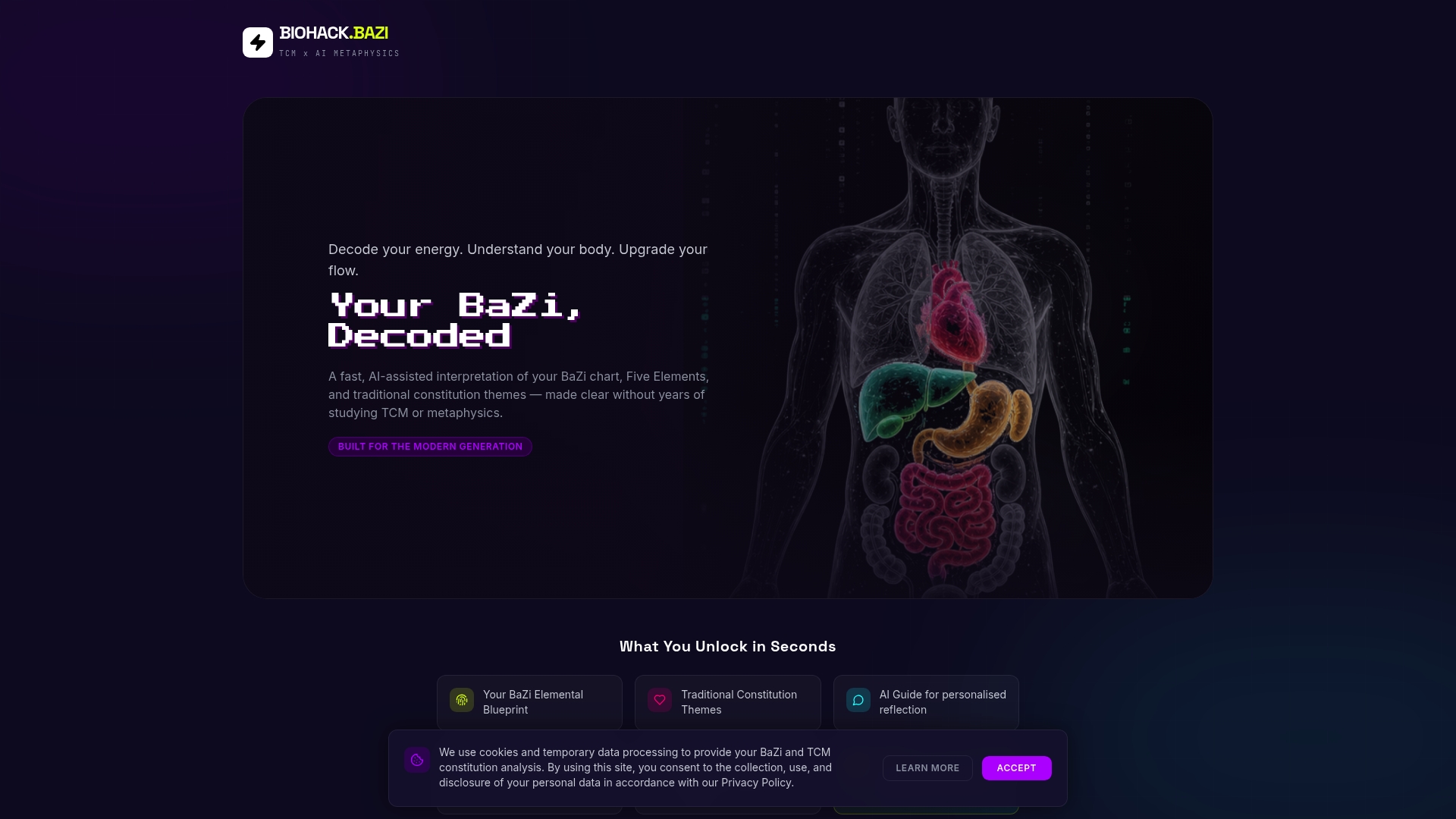
Users can download a bilingual Mandarin and English PDF report, and additional features like daily energy trend tracking may be accessible after account creation. This is a self-reflection tool built for curiosity and personal insight, not a diagnostic or medical service, so pair anything that resonates with a licensed practitioner if it touches on an actual health concern. Try the free BaZi calculator now and see what your chart reveals about your elemental balance.
Sources
- Transforming wearable data into personal health insights using large language model agents | Nature Communications
- An AI health coach could change your mindset | Stanford Report
- Use of generative AI chatbots and wellness applications for mental health — An APA health advisory
- Development and application of artificial intelligence in traditional Chinese medicine research and development | PMC
FAQ
Which 3 Jobs Will Survive AI in Wellness?
Roles requiring hands-on clinical judgment, licensed diagnosis, and crisis intervention are the most resistant to AI replacement, including physicians, licensed therapists, and hands-on bodywork practitioners like acupuncturists. AI tools are built to support these roles with data and triage, not replace the human judgment and physical presence they require.
What Is the 30% Rule in AI?
There’s no single, universally recognized “30% rule” specific to AI in wellness; the phrase is used inconsistently across different contexts and industries. If you encountered this term referencing a specific study or framework, check that source directly rather than assuming a standard definition.
Is There a Health Version of ChatGPT?
There’s no single official “health version” of ChatGPT, but purpose-built AI wellness tools like agentic wearable-data systems and LLM health coaches serve a similar function with more specialized design. Tools like PHIA and Stanford’s Bloom app are research examples built specifically for health data interpretation and coaching, rather than general-purpose chat.
Which Healthcare Jobs Will Survive AI the Longest?
Jobs centered on direct patient relationships, physical examination, and complex clinical decision-making, such as surgeons, nurses, and mental-health clinicians, are expected to remain human-led the longest. AI is increasingly handling administrative and data-interpretation tasks that surround these roles, not the roles themselves.
Can AI Replace a TCM Practitioner or Doctor?
No. AI tools, including Biohackmybazi’s BaZi and TCM constitution analysis, are designed for education and self-reflection, not diagnosis or treatment. Any AI-generated insight that touches on a real health concern should be discussed with a licensed practitioner.